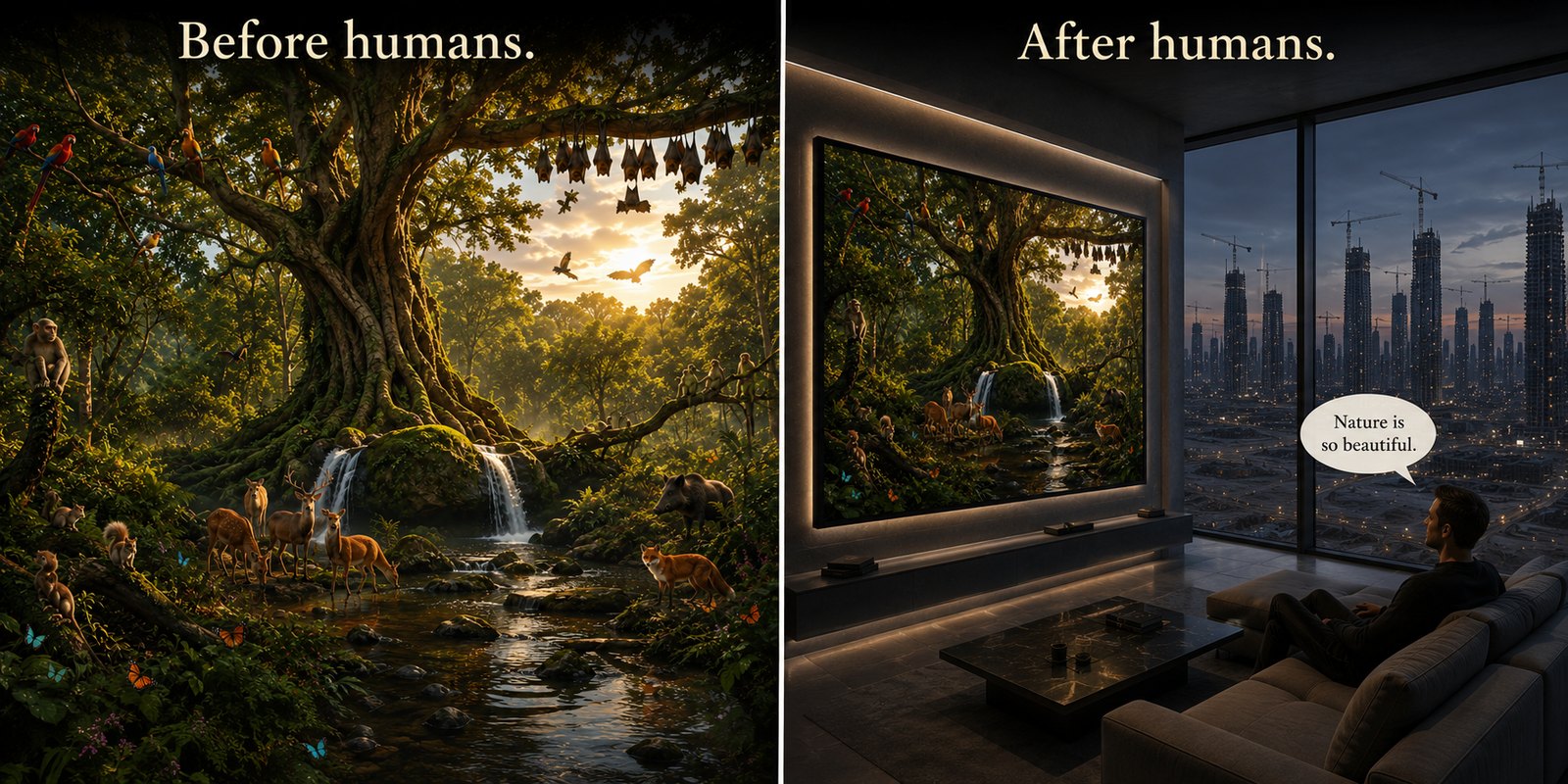
People tend to connect more easily with wild animals than with farmed animals. When stories of wild animals are told, people naturally side with the animals, perhaps also due to not realizing our society is based on the genocide of wild animals; they feel they have no foot in this crime. The story of Ruti the hyena is an example of one that touched many hearts in Israel.
No names, no faces, no stories. When I give lectures about the wild animal genocide, I put a question: "there are trillions of victims, each year, that die due to human activity. Please tell me a story of a single victim". No one ever raises their hand, and this is also the case when the audience is comprised of many environmentalists. There was only one exception, when a woman knew a story of a bird that was shot by a hunter and saved, lives happily in a sanctuary, and obviously was given a name. The exception shows the rule: no names, no faces, no story. What is a story?
But what about polar bear pictures? they are symbols, a frozen moment in time, not a sequence of changes in a particular individual's life. We can find some individual stories on National Geographic, but those usually hide the human influence (though that may have changed somewhat in recent years). By the way, I also think relatable stories about individual farmed animals to are very seldom told. This is why we need Animal storytelling, which can strengthen animal personhood (at Sentient, we try to tackle some of these issues with the Camera on Animal tech).
We need names, but we need numbers as well! I was born and raised in Israel, a country living in the shadow of the Holocaust. Every Israeli knows the number 6 million (Jews killed in the holocaust), and the story of Anne Frank. In my opinion, these two represent the fundamental elements that structure memory and recognition of atrocities: the story of the one, and the extrapolation to millions. Without a story, there is no emotional connection; without big numbers, it is a personal tragedy, not an atrocity. The main difference between a massacre, slaughter, pogrom (which are also not used in environmental terminology) to the term genocide is the sheer volume of suffering and death. It's about the numbers, It's about the individual story. It's both.
This is a translation of an op-ed I published in Hebrew in Haaretz newspaper.
The Overlooked Sentience in Environmental Discourse
The environmental movement talks mainly about climate and the environment, using words such as "renewable," "green," and "sustainable." However, there is an absence, metaphorically but also literally: we don't talk about the feeling beings within the environment, the consciousnesses within it, the animals.
These animals are being exterminated, and we are in the midst of eradicating wildlife off planet Earth. According to the Living Planet Index, since 1970, due to human activity, there is an average decline of 69% in the populations of birds, mammals, reptiles, amphibians and fish. The remnants, less than a third of the original numbers, are those many trillions of individuals living in nature. Each and every one of them feels and experiences subjectively. In the Cambridge Declaration of Consciousness, experts acknowledged that many, if not all of them, possess consciousness. These, although they are the majority in the world, in numbers, constitute a minority in power and influence.
They are the voiceless who are relegated to the sidelines of discourse surrounding ecological, climate, and environmental issues, despite the fact that they are the ones living within it, the main victims of the climate crisis and the destruction of their homes.
The environmental terminology is killing the individual animal. The language used by climate activists and environmentalists overrides the subjective experiences of wild animals, and those experiences are what truly matters. So, on top of their habitats being destructed, their stories are left untold. The physical elimination of the majority of individuals on this planet is accompanied by the cognitive elimination of them as separate entities deserving moral consideration.
Lost in Translation: Decoding the Environmental Language
How does our language erase the immense crime committed against wild animals from our collective consciousness, and does this extend far beyond just environmentalists? We talk about the environment and the trees to obscure the massive annihilation of sentient beings.
Pay attention to the trick. The words "environment" or "nature" lump together rivers, rocks, ants, air, mountains, monkeys, and so on. Defining animals within a framework that includes insentient organisms like plants blurs the enormity of this catastrophe, and the word "environment" predefines everything it encompasses as utilities and resources whose role is to serve humans.
My personal association with terms like 'environmentally friendly' often leans towards a decorating committee or a gardening project, certainly not towards a field implicated in some of the most severe moral atrocities ever acknowledged. The word "environmental," as the defining word of the movement to save the inhabitants of this planet, should have been retired long ago.
Actually, the word "greenwash" is itself greenwashing, because the word "green" excludes the sentient beings at the expense of the insentient. But what is there to hide? The internalization of the fact that we have exterminated most wild animals on Earth, the Wild Animal Genocide. The word "Genocide" is comprised of the Greek word for race, or type, and the Latin word for killing.
Animal Genocide is the systematic murder of wildlife in such large numbers that they cannot be measured. How many did we kill? No one knows, but the number of fish that humans pull from the oceans every year is probably more than a trillion, that is, 1,000 billion sentient individuals. The environmental terminology creates a world-image that distracts us from the simple but horrifying truth: we are losing our very basic humanity as we exterminate the free beings who do not belong to the small human elite.
It is important for me to emphasize that I am not against the use of words such as "ecology" or "climate." These are important terms that describe reality at the macro level, but they have no place for the individual.
They have no place for the monkey who died from starvation because the rainforest he lived in went up in flames, or for the small turtle that did not manage to escape the fire. His burnt shell, his refuge, became his grave.
They have no place for the butterfly, the snails, the parrot, and the bat whose sources of food, protection, and life have been erased.
Individuals Lost, Stories Erased
As a species, we do not tell the personal stories of the individuals affected because they are erased from the language and thus erased from our mind. Their omission from the world image that is created in our minds is no less successful than their eradication off the face of the Earth. In order to stop the mass genocide, we need to start talking about them clearly as individuals, and we need to start talking in terms of Animal Genocide, the destruction of biological nations by the human animal.
What we are doing is a crime against the world, a significant part of which is carried out by weapons of mass destruction, such as the trawlers (a kind of marine hunting boats) that are dragging nets across the sea and killing everything caught in them.
"In each and every letter there are worlds and souls and divinity," said the Baal Shem Tov, the Jewish mystic who is regarded as the founder of Hasidic Judaism. And if there are worlds in letters, what can we say about words? I read and listen to the language that disregard the majority on this planet and cringe. They do not contain worlds and souls and divinity, but the denial of a simple truth: the human animal is systematically killing the free animals in the world. This is a sentence that should be said again and again and again until we realize its meaning and internalize it.
Genocide as the Crime of All Crimes
Genocide is a term that represents the crime of all crimes. The United Nations Genocide Convention sets up a definition that was interpreted in a way that excludes so many cases from it, that the only two clear genocide cases in history that are in consensus are the Jewish Holocaust (the prototype) and the genocide in Rwanda. But clearly, because such a narrow case definition doesn’t help protect populations in many cases, sub-terms were made: politicide (Stalin's killings are not considered genocide due to Russian pressure on the definition), gendercide (killing members of a specific gender), and so on.
Animalcide Regarding the word genocide, you said: “Genocide involves the active pursuit of the extinction of a group. Humans cause suffering, death, and extinction to other animals only as an indirect consequence (by-product) of other activities. In fact, no one actively seeks these results.” Genocide is a term that represents, for the population, the ultimate crime. The United Nations Convention on Genocide establishes a definition that has been interpreted in such a way as to exclude so many cases that the only two clear cases of genocide in history on which there is consensus are the Jewish Holocaust (the prototype) and the genocide in Rwanda. But since such a narrow definition fails to protect populations in many cases, sub-terms have been created: politicide (the murders committed by Stalin are not considered genocide due to pressure exerted by Russia on the definition), gendercide (the murder of members of a specific sex), and so on.
I suggest adding "massacre of animals" to these definitions in order to broaden the scope of the UN Genocide Convention. But even without that, I believe that what is being done to wild animals is clearly genocide as defined by the UN Genocide Convention: "acts committed with intent to destroy, in whole or in part, a national, ethnic, racial or religious group, as such," including the killing of its members, causing serious bodily or mental harm to members of the group, and deliberately imposing conditions of life calculated to "bring about the physical destruction of the group in whole or in part." The victims are targeted because of their actual or perceived membership in a group, not randomly. Animals are not targeted randomly; they are targeted because they are non-human animals. Weapons of mass destruction (like trawlers) are designed to kill animals, and other methods of mass destruction, like fires started by humans to destroy rainforests, deliberately impose living conditions intended to "cause their total or partial physical destruction," without which there would be no free space to raise cattle or grow soybeans to feed pigs in China, for human habitation, and so on. This is the human dogma that disregards animal life, and in many genocides, victims have been likened to animals: Jews to rats, Tutsis to cockroaches. Wild animals use resources that humans want to seize—usually the land and what it contains. Furthermore, the bodies of these wild animals are also considered a usable resource. Thus, over a trillion fish are taken from the ocean every year by humans.
If a country were to kill millions of innocent civilians in a massive bombing raid without any provocation, the world would see it as genocide, and claims like "we just want their land, we don't want them dead" wouldn't suffice. I think actively seeking to kill animals is exactly what humans do—for example, concrete is the technology that's supposed to prevent any life from arising. But it's a bit semantic: was death itself the goal, or the outcome of death, for example, the lack of a political uprising against Stalin or the fact that Congolese people harvest more rubber, as in the case of colonial genocides in Africa?
Advocacy for Wild Sentient Animals
I find it quite surprising that while we have groups dedicated to farmed animal protection, stray animal rescue, and the welfare of animals in labs, but the largest group — wild animals — seems to lack dedicated sentient centric advocacy, maybe except for the suffering caused by natural reasons. IMO, there appears to be a need for an organization that champions wild sentient-focused advocacy, though I'm concerned it could lead people to believe that natural lives are inherently positive, mirroring conservation groups' views. I wonder what Brian Tomasik would think about this.
Sentient-focused advocacy can have different repercussions
Sentient-focused advocacy can have different repercussions, e.g., what people say when asked why they are vegan. So the classic trio is for the animals, the environment, and health. Let me reframe by switching focus: for the farms, the wild animals, and the human animal. The first one makes no sense because we used to see the environment as devoid of intrinsic value, merely an instrument. It's something that, almost by definition, we should not care about per se. And this is how we use the word when it comes to our urban environment.
A massive explosion in the city of Paris causes massive environmental destruction
So, if a rainforest is destroyed with its monkeys, snails, and butterflies, it is an environmental issue, but when a city is destroyed with its people, it's a war crime, never (primarily) an environmental issue. Applying the environmental terminology to the human world, we might say, "A massive explosion in the city of Paris causes massive environmental destruction, and grey activists (like green activists, but for the city) are working to clean the area and make it as safe as possible. Despite this being the third attack this year, conservation efforts of the population continue and have had major success over the last half-decade”, all without mentioning that people were killed in the terror attack.
The holocaust
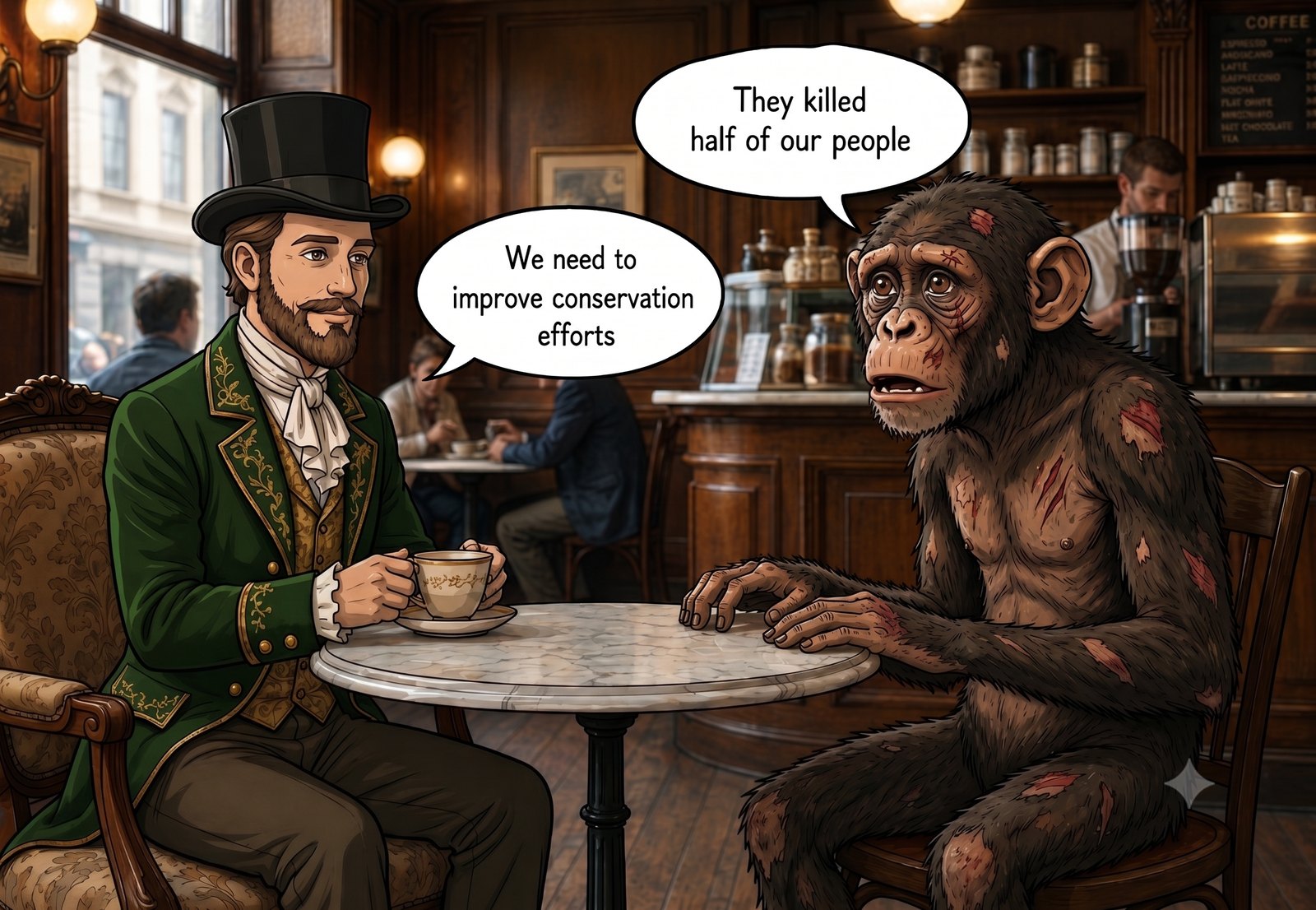
- Another example: "In the '40s of the previous century, there was a subspecies of monkey in Eastern Europe that experienced a massive decline in population, but conservation efforts succeeded, and now the population is back to normal" (this monkey subspecies are Jews). I just told you the story of the jewish holocaust. התמרה טרנימולוגית, הרחבת טרמינולוגיה לשדות שונים
Primate Genocide and the Tutsi
This washing effect of environmental discord struck me first when I read an article titled Primate Conservation: Is the Cup Half Empty or Half Full?, and realized More than 300 million monkeys were killed due to deforestation in the nineties, an unbelievable number, but it is sugarcoated in scientific and environmental jargon of conservation. Let's try this with humnans: "Tutsi conservation: is the cup half empty or half full?". It sounds absurd…
Extermination vs. Extinction: A Comparison
The terms 'Extinction' vs. 'extermination' are very different. Extinction highlights the last individual. As long as some are alive, there could be a danger for extinction, but it hasn't happened yet. At its core, it is a binary situation; a species is either still here or has been extinct. With this focus, we are not necessarily worried that, say, 50 million individuals died because that doesn’t mean the species is near extinction. When talking about humans, it is about extermination because every individual counts. Going back to the example of Israel, every Jew known that 6M people were killed in the Holocaust, but the majority don’t know that the Jewish world lost 1/3 of its people in the Holocaust, and that jewish population recovered and is currently slightly below its pre WWII numbers. When talking about extermination, each one is counted for their own, but with extinction, the individual’s value is derived from being part of a whole. No one knows how many wild animals humans kill, and no one (that I know of) tried to count them; even the Living Planet Index is an average of the decline in population; you can't extract a number of victims out of their statistics (and it very hard to do anyway).
Concrete and answer to the "no one seeking this genocide" argument If a nation were to kill millions of innocent civilians in a massive bombardment without any provocation, the world would see this as genocide, and claims that “we just want their land, we don’t want them dead” would not suffice. I think actively seeking to kill animals is exactly what humans do - e.g., concrete, for example, is the technology that's supposed to prevent any life from arising. But it's a bit semantic: is it the death itself that was sought, or the outcome of death, e.g., no political uprising against Stalin or having the Congolese harvest more rubber, as with colonial genocides in Africa.
Ruti: A hyena's tale People tend to connect more easily with wild animals than with farmed animals. When stories of wild animals are told, people naturally side with them, also because most don’t realize our society is based on the genocide of wild animals. Unlike farmed animals, whose deaths for food we acknowledge, the reason for killing wild animals seems less direct. In Israel, there was a story about a hyena named Ruti. It began on April 1st with a post “by Ruti” thanking a city mayor for deciding not to destroy her home. It was an April Fools' joke. People believed it, and when they realized the building plans were not canceled, impacting Ruti, some literally cried. Interestingly, some people who were initially afraid of Ruti, thinking she was male, felt calmer once they learned she was female — a distinction that, biologically speaking, makes no sense.
Why I favor the term Animal Genocide I favor the term "animal genocide" because it shifts the dialogue from biology to social science, opening up a discussion about victims, survivors, weapons of mass destruction, crimes against animality, maybe the role of the UN in all this. While environmental language has evolved in recent years — with movements like Extinction Rebellion changing the discourse — I'd prefer terms like "Extermination Rebellion." I'm not suggesting everyone should adopt this terminology, but considering the immense suffering of wild animals is arguably the greatest on the planet, I think such advocacy can have an important role.
The Monumental Crime Against Wild Animals don’t have a name The historian Yuval Noah Harari said, “Animals are the main victims of history, and the treatment of domesticated animals in industrial farms is perhaps the worst crime in history.” I've never heard anyone say that what we do to wild animals is the worst crime…, and although 'industrial farming' might not be the best name for the slaughter industry, we don’t even have a clear word to describe the mass killing of most wild animals on earth during the last 50 years.
Do you think The Environmental Terminology Is Killing The Individual Animal Do you think the Environmental Terminology Is Killing The Individual Animal? I think so. It clearly highlight the insentient, e.g. trees and rivers (the color of the environmental movement is green), and hides the Sentient, e.g. the monkeys and squirrels. Even animal rights activists say things like 'the meat industry is causing deforestation', but I almost never 'the meat industry is killing wild animals'. I think a language that highlight the feeling ones while looking at the natural world, can lead (to give one example) to viewing what is done to wild animal as a genocide, animal genocide, as opposed to viewing it as an Ecological Destruction or Climate Crisis (the climate is actually not the one in crisis... it is a means, not and end to itself. it is a bit like saying temperature crises, or precipitation crisis, it highlights the insentient, though I can relate to the functionality of the term, I think it is important, but it is not accompanied with the right sentiocentric terms)
Wild animal genocide has no stories
With wild animals, there's no story and no numbers. When I give lectures about this topic, I say to the audience - and this is also the case when the audience is comprised of environmentalists - there are trillions of victims, wild animals, each year, that die due to human activity. Please tell me one story of a single victim. No one ever raises their hand (except for one woman who knew a bird that was shot by a hunter and saved, lives happily in a sanctuary, and was given a name). The mass extermination of wild animals has no face, no story. Polar bears are important, but they are symbols. A frozen picture, not a change in time (which is a story), not a particular individual. We can find some individual stories on National Geographic, but those usually hide the human influence (though I think there may be some change in that?). Symbols represent suffering of individuals, not a mass atrocity.(BTW, I also think farmed animals seldom have individual stories that people can relate to as well. Animal storytelling, leading to animal personhood and focusing on the individual, is very much missing. At Sentient, we try to tackle some of these issues with the Camera on Animal tech.)
Fundamental elements that structure memory and recognition of atrocities
I believe it is more than just individual animals being under-represented in the climate-environmental debate. I was born and raised (and still live) in Israel, a country living in the shadow of the Holocaust. Every Israeli knows the number 6 million (Jews killed in the holocaust), and the story of Anne Frank. In my opinion, these two represent the fundamental elements that structure memory and recognition of atrocities: the story of the one, and the extrapolation to millions. Without a story, there is no emotional connection; without big numbers, it is not considered an atrocity. The main difference between a massacre, slaughter, pogrom (which are not used in environmental terminology), or, even, but perhaps to a lesser degree, extermination, to the term genocide, is the sheer volume of suffering and death. It's about the numbers.
The Extermination of the Free and Slaughter of the Captive If an alien journalist came to Earth, perhaps they would title the story of this planet as “The Extermination of the Free and Slaughter of the Captive,” plus addressing wild animal suffering from natural causes. The environmental language is so far from depicting what is happening to wild animals in the terms they deserve - crimes against animality, mass extermination, and so on. This language doesn't stay in the realm of the environmental movement but spreads far and wide, so even many animal rights activists are not aware that a massive killing of wild animals is perpetuated. Some ask me, “Really? Why are they killing wild animals? We didn’t know".