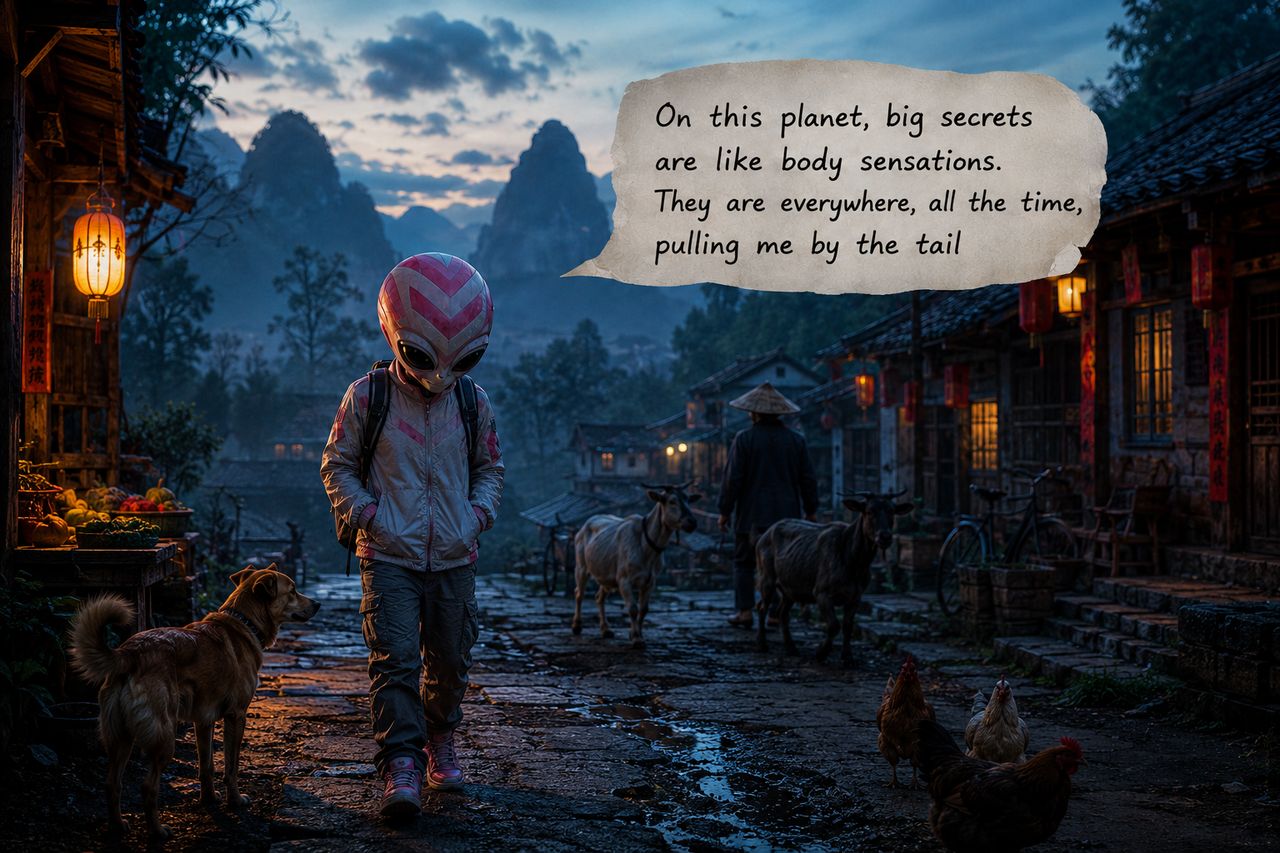
The big secrets have a secret. The Secret of Secrets. I don't know what it is, but I know it is probably everywhere I look. I often think about big secrets I am aware of and exploring, and about ones I am ignorant to, despite them constantly staring me in the face.
Once upon a time, an ancient squirrel came to the big secrets and said, "You are mighty, you are colossal, you will be easily spotted. Do one of the two - either hide really well, so that no one can see you, or conversely, be everywhere, at every moment, in every corner. In both cases - no one will know about you, and your great secret will be kept".
The big secrets were perplexed. Which option should they choose? Although there was initial disagreement among them, they quickly understood that they had no real choice. They are not small, they are not agile, how could they manage to hide from so many different animals going to so many different and strange places? Hence, they chose the second option, to be everywhere, all the time. That way, even if by chance you notice that they are here, others would think you're mad. No one would believe you, because how come no one else noticed?
If the big secrets had chosen to hide, it would be possible to take someone and say 'Look, behind that playground slide there is a big secret burrowing in the sand,' but it's not possible because they are also behind the playground slide, and right here, both above and below.
For many, many years, the big secrets have been hiding in plain sight. To uncover them, one must simply pay attention to the here and now. And when you stumble upon a big secret, draw near, for it will gently and truly whisper in your ear: The biggest secrets are the most apparent ones. That is the secret of secrets.
As an investigative journalist I have tried to be a fly on the wall, bring the hidden exclusives that no one else has access to. It took me years to understand that the biggest secrets are hiding in plain sight, and uncovering them is the most profound, astonishing, and important investigation one can make.
Just recently I have found that songs are constantly playing in my head, not a stuck song syndrome once in a while, but an everyday ongoing phenomenon that is distracting my attention. I came to see this because I started meditating on observing my thoughts. This phenomenon has been with me for probably 30 years, maybe more. I just never noticed it, and didn't understand how frequent and attention intensive it really is.
Big secrets are hiding inside but they're also hiding outside. As a child, I used to walk to school. Part of the way was paved, and part of it passed through a small vacant lot. It occurred to me that this pavement came at the expense of animals, but I was very far from internalizing it as the genocide it is. The wild animal genocide is a huge secret. Once you uncover it, it's everywhere. In all probability, you are looking at it at this very moment (ya, where are you right now?).
Practicing Vipassana in the Goenka tradition has taught me that I am constantly reacting to my physical body sensation, and my actions emerge from this reaction. My misery comes from not responding with equanimity to these sensations. It does not (directly) come from an outside reality, or, as I like to put it, "Buddha was a statistician".
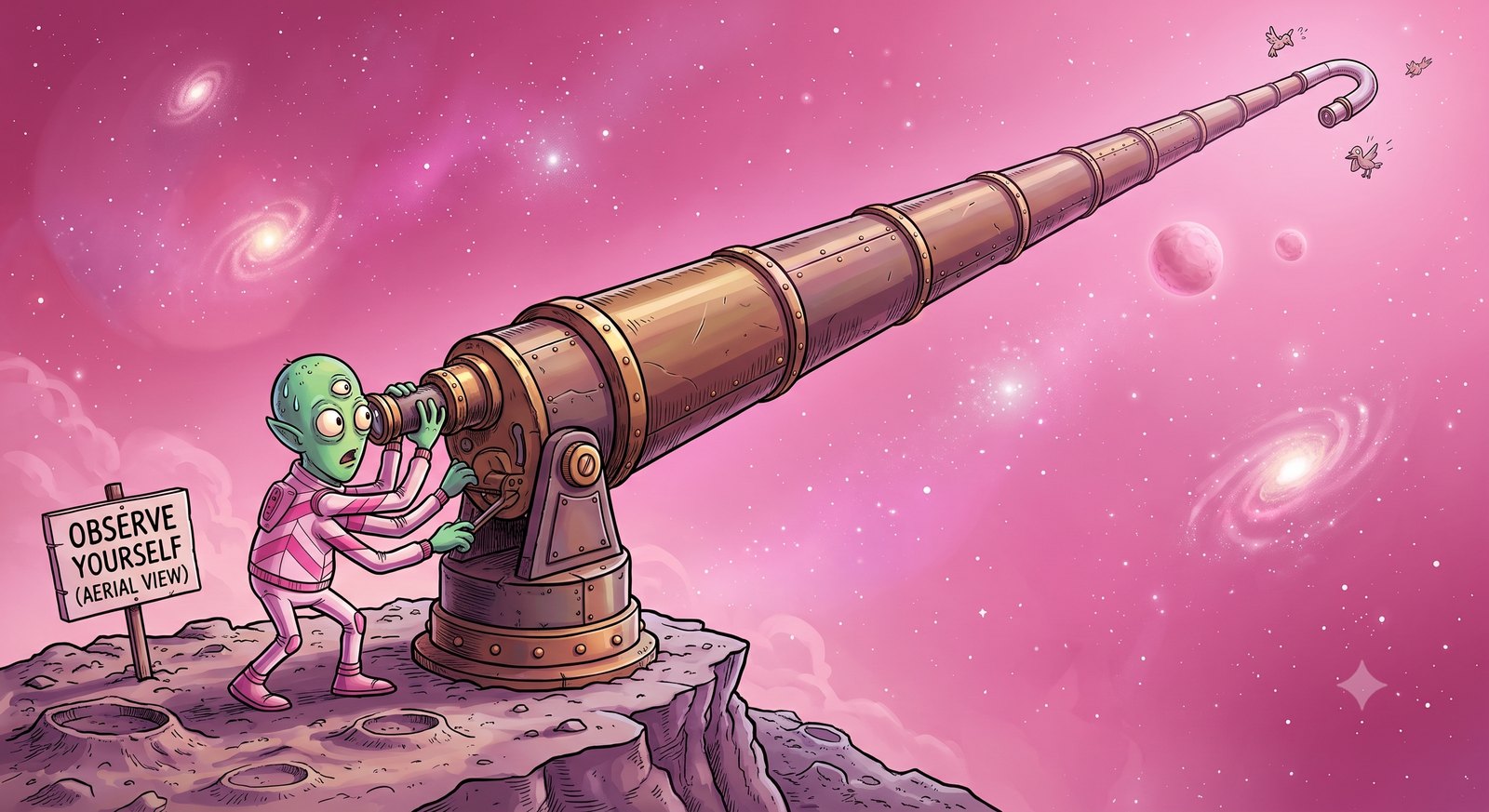
You always look, but have you looked at what is looking?
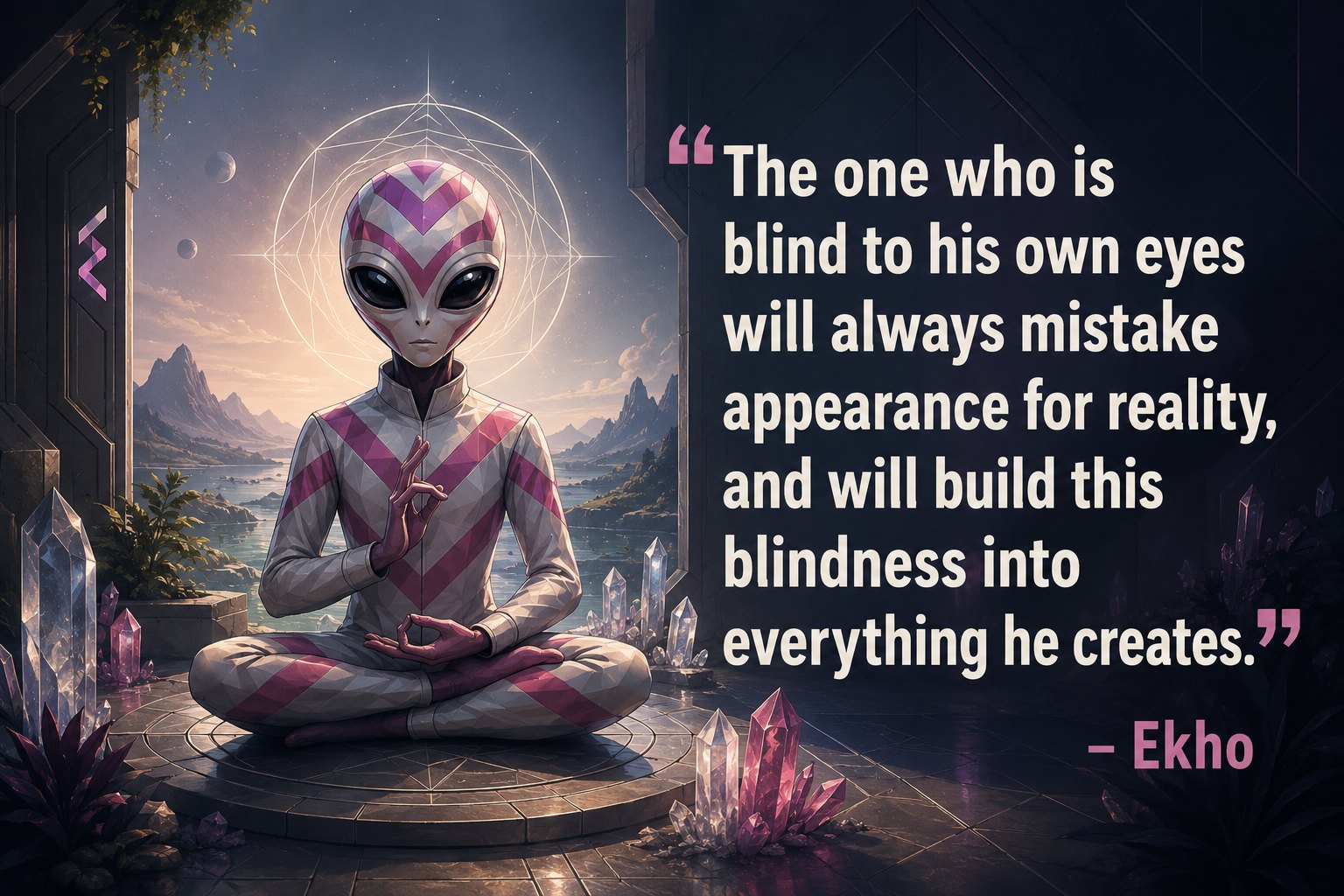
If you really wanna investigate the world, you have to look at your own eyes, which is kinda like simulating yourself, but not exactly. I am not sure...
In a truly unbiased investigation, one eye is on the information from experience, and the other is on the information of experience. One eye on the data, another on the simulating tool that is mediating this data.
You have never looked at the real world. You only perceive through your mind, converting inside changes in your body, originating from "outside" signals, into something completely different in quality and essence; You experience green because photons change molecules in your retina, but neither the photons nor their wavelengths are green or red; they have no color. The forest is silent, yet human language constantly describes the world around us in terms of experience. This is deceptive. The room is never orange. It is orange to you and green to a deer.
The connection between the experience of green and the frequency of light associated with it appears arbitrary, although it is consistent. Nothing about the frequency itself explains why it should feel green rather than like some other color. Think about it: changes in matter is reflected in experience.
So how shall we view the world outside? it is colorless and silent. It contains wavelengths and subatomic particles, but color, sound, smell, taste, and touch arise only when particle motion is converted into experience. The outside experience world is not beautiful or full of sound.
The forest is silent, whether a tree falls or not, whether someone hears it or not. This video explains it very well:
Great confusion arises out of this phenomenon, as I tried to explain in this 5 minutes talk about human language describing subjective experiences as objective realities:
After practicing Vipassana for six years, I’ve found it to be transformative in several key areas of my life and activism. It has helped me mitigate bias by allowing me to observe my sensations without reacting blindly to them, leading to better decision-making. It has improved my relationships with fellow activists and given me a clearer, more truthful perspective on the world, which I now see as consisting of subjective experiences. Although I address some criticisms near the end of this post, I highly recommend trying Vipassana as a tool to improve one's effective activism and happiness.
Epistemic Status
I am far from deeply understanding the Vipassana tradition and the Buddhist Noble Truths. It could be that I am underrating or overrating the effect that Vipassana could have on the animal rights community.
Background about Vipassana and Me
I have been practicing Vipassana meditation for 6 years now, and it has had a significant influence on my activism. I tried different methods of meditation over the years but never really spent much time and effort on it until I went to a Vipassana course, as taught by S.N. Goenka, in 2018. Since then, I have completed 6 courses and practice approximately 4 hours a week (most of the time, with some breaks).
Vipassana meditation, as taught by Goenka, is a widespread meditation tradition practiced in centers all over the world. Its entry point and main yearly routine is a 10-day silent retreat, with meditation for ~10 hours a day, in a very strict regime where the focus is on learning the technique. This meditation emphasizes body sensations, claiming that our feelings and actions all derive from our reactions, with craving and aversion, to those pleasant or unpleasant physical sensations we have. The whole technique is based on becoming more sensitive to these sensations and not reacting to them but just observing, like a scientist watching an experiment. Quite uncommonly, this technique has been developed and taught (in recent generations) by laypeople, not monks. Its origins are in Theravada Buddhism, claiming its teachings come from Gautama Buddha.
Mitigating Bias
The core principle of Effective Altruism is trying to logically and objectively look at the world and understand what interventions would cause the most good. Mitigating bias is a crucial part of this outlook, and we are all very much biased; by the information we've encountered in our lives, our misunderstanding of statistics, logical fallacies, and more. But perhaps the most fundamental bias stems from our likes and dislikes, cravings and aversions, as manifested in pleasant or unpleasant body sensations.
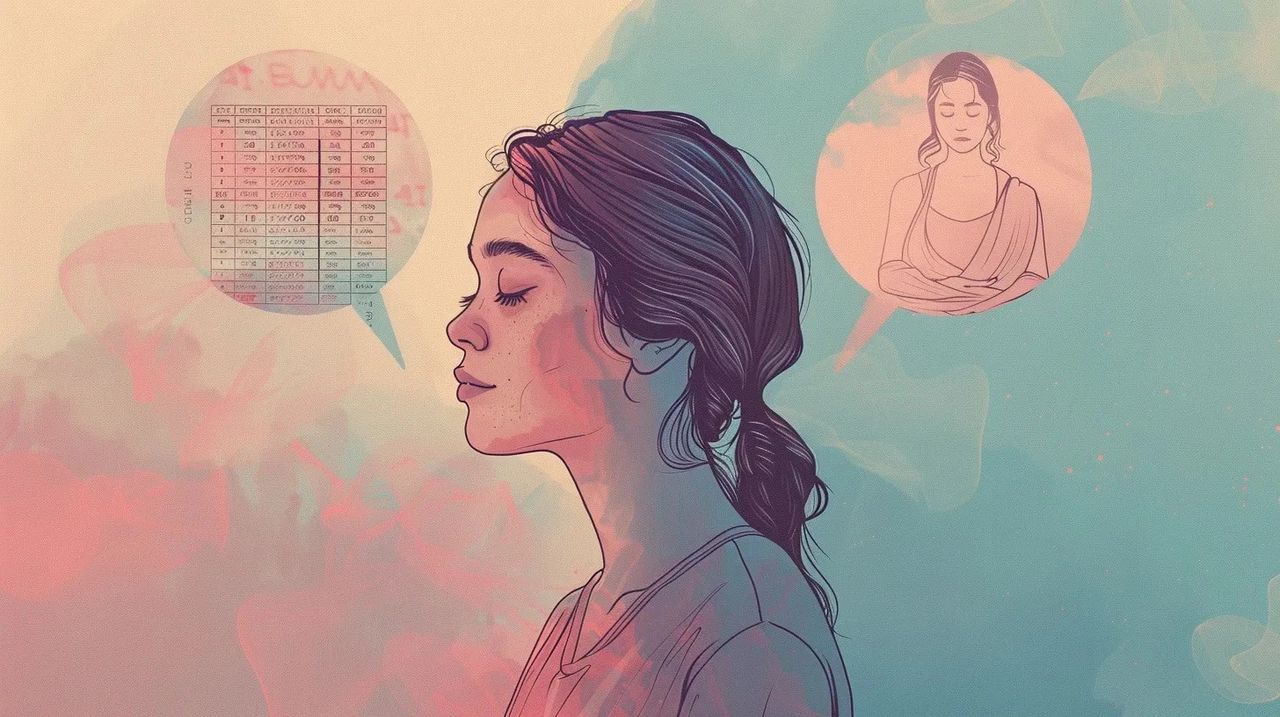
Let's assume I need to prioritize between two projects: one full of bureaucracy which I really hate, and another that sounds like fun 🙂. The EA way of mitigating this bias might involve techniques such as a Weighted Factor Model, usually an Excel sheet with lots of numbers. This is good, but we know it can only take you so far. You and I can trick ourselves into choosing what feels pleasant, whether by adjusting the weights of the factors, the numbers we assign, or in some other way, and my assumption is that we do this much more than we're willing to admit or are aware of. Moreover, we don't have time to do a weighted factor model for every decision, and sometimes the accumulation of many small tactical decisions turns out to be no less important than the big strategic ones (path vs. execution).
So how else can we mitigate this bias? This is where Vipassana comes in. I learned how to observe my physical sensations without reacting to them (or not as strongly as I did before), thereby decreasing their power and effect on me. Additionally, I became more aware of these sensations, which helps me rationally take them into account. I see Vipassana as a complementary way to mitigate bias, right alongside the numbers and formulas. I feel I need both.
A small example: Your co-worker said something really hurtful, making you feel they don't appreciate your current effort on the project. You feel your stomach ache, and you lash out, telling them it's none of their business to assess your work. That was probably not an effective way to handle the situation, and you were biased by your hurt, your unpleasant stomach sensations. If you were to observe them, maybe their power over you would decrease, and you would be more aware that they are causing your reaction, not some logical, cold cost-effective analysis of the situation. From cause prioritization to responding to a day-to-day email, it seems to me that awareness of body sensations can be a tremendous tool in mitigating bias.
This can also work the other way around! Vipassana meditators tend to be more alert about their sensations and may decide beforehand not to put themselves in situations that will trigger unpleasant sensations, such as the high-bureaucracy project. They tend to take better care of themselves, which can be a positive thing and decrease burnout, but can also lower their flexibility and make them work more for themselves than for the cause. Personally, I feel like I became more flexible; my array of legitimate possibilities, think about this as the Overton window of action, regulated by yourself, got wider. Yet, I think that it can also get narrower, depending on the person and how they try to use this Vipassana tool. This is a very profound question, but my guess is that generally, it's not always the case that Vipassana tends to shift the balance between taking care of yourself and taking care of others into the sweet spot where you both gain. Nevertheless, I personally feel I am a better activist with Vipassana, and I think this may be true for most people doing it.
Buddha was a Statistician
What I learned from Vipassana made me look at Buddha as a statistician. He is practically telling me this: "Look, Ronen, you have ups and downs, shit happens, but your problem is your lack of internalization of one of the most basic principles of statistics: correlation is not necessarily causation. Get it? I know you wouldn't. Here's the thing: stuff you don't like happens to you, that person said something mean, this project was not successful, a friend died, and you feel bad, and you internalize that this is causation. Because all this stuff happens, you feel so, but actually, you are missing the mediator variable,which is the body sensations. Your reaction to them is the cause of your suffering”.
“So the project failed (this is the outside change) → unpleasant body sensations arise → you react to those sensations → you suffer. Your reactions and thoughts to the sensations only make them stronger, and you are caught in a loop. The misery comes from your reaction to the physical sensations, not the outside reality. If you internalize this understanding, you will be much better off”.
"OK, fine," I say, "but you do realize that throughout my whole life, 41 years, I have seen this correlation between external things and how they affect my internal state. It’s hard to imagine this is not actually causation. I’m feeling this right now while talking to you—I suffer because of this conversation and because I don’t really understand you".
"No, you suffer from your reaction to the sensations that arise in your body after I tell you something you don't want to hear", Buddha says in responce. "It is not because of my words; it is because of your reaction to the agitation in your body. If you realize this, your life could change for the better".
Seeing the World as It Is?
The word Vipassana means "to see things as they really are”. Practicing for years has made me look at the world much more as subjective experiences as opposed to objective realities, and I think it made me more compassionate and less discriminatory. It also made me think about what I see as a very destructive and poisonous feature of human language - describing subjective experiences as objective realities. I strive to be a lucidian, meaning someone who internalizes that there are only experiences. I am far from that, obviously, but Vipassana has brought me closer.
Relationships with Activists
The most obvious and perhaps fastest impact of Vipassana on me was the improvement of my relationships with advocates in the community and people I work with. Observing the sensations makes me respond in a much more thoughtful way. I come from Israel, where about a decade ago we experienced very harsh infighting within the community, and I think if more people in the community were practicing Vipassana, the infighting would have been mitigated to some extent.
Criticism of Vipassana and Theravada Buddhism Relevant to Activism Work
The Buddha and his followers speak of the liberation from suffering for all sentient beings, but this remains—at least in my limited understanding—an abstract thought, not a vision toward which a clear path is being carved. I think this is an important indicator of a problem or a missing piece. As it stands today, Buddhism is an elite religion that is only relevant to a tiny fraction of the sentient beings on Earth. As far as I can tell, and I might be wrong about this, Buddhism does not claim to have a real solution to the enormous suffering experienced by non-humans (particularly in the wild, i.e., wild animal suffering), and most of its followers are not actively pursuing a solution to this either.
"May all beings be happy" is chanted very frequently by Vipassana meditators, but what is the practical solution? Visionaries like the British philosopher David Pearce draw parallels between the Buddhist goal of ending suffering and his own "Hedonistic Imperative", which advocates for the use of biotechnology to eliminate suffering in all sentient beings. Compassion alone is insufficient to achieve this goal. Instead, he is promoting high-tech solutions, such as genetic engineering, neurotechnology, and other advanced scientific methods, as necessary to truly eradicate biological substrates of suffering.
My point is not that his specific solutions are right, but that he is trying to solve the biggest problem of suffering. Vipassana (or maybe Buddhism), as a system, as a philosophy, as a technique, as a way of life, is not. Its presumption is a path to free human animals, and although this can also tremendously help animals, I don't think it goes a step further to look at the big picture (as EA does), nor do its followers. One could say that strategically this is for the better that these teachings are staying, in some way, anthropocentric.
Generally speaking, I have the impression that Theravada (The Way of the Elders), which Vipassana is part of, is less activism-oriented, and Mahayana (the Great Vehicle) is more activism-oriented, as can be seen by their interpretation of concepts like bodhisattva - beings on the path towards liberation, who according to the Mahayana tradition may even postpone their own enlightenment in order to help others.
Goenka Vipassana is not for everyone, probably not for most people. It is long, very demanding and strict. Moreover, it is quite exclusive in the sense that, unlike other traditions which see the path to enlightenment as containing a combination of many techniques, Vipassana suggests that you should pick one and focus on that.
Some religious remnants are still left in this technique, which (to my limited understanding) are not based on experience and logic, such as believing in karma (a person's present circumstances arise as a result of their actions in this life and past lives).
Personal Recommendation
My recommendation is totry Vipassana, as taught by Goenka, at least once. Although 10 days is a long time, it will probably be worth it, and even just one course can help (to some extent) mitigate biases, see the world in a more accurate way, and be calmer and happier, which is also not a bad thing in itself!
Another recommendation is at the organizational level. At Sentient, we continue paying workers while they attend a Vipassana course; we consider this an important form of professional training for activists, for all the reasons I mentioned earlier and more. Three of our workers or board members have done a Vipassana course since we initiated this policy. You can implement a similar policy in your organization, whether for Vipassana or any other meditation technique you find valuable for advocates. If we pay workers while they are participating in Monitoring, Evaluation, and Learning practices, why not for meditation? Rest assured, it is not a retreat for rest or luxury, nor does it resemble a vacation. In the case of Goenka Vipassana, you are working intensely, waking up as early as 4:00 AM every day.
Vipassana meditation has helped me address three major questions: What is (by transforming how I perceive the world), what is good (at the emotional level), and how to achieve it (by reducing my biases). I believe that if we, as a movement, were to embrace meditation techniques more widely, it could increase our effectiveness.
During the last eight years, I have been only practicing vipassana consistently for maybe five years, and in those five years maybe an average of four hours a week. Why?
I could be very wrong about this:
The Buddha and his followers speak of the liberation from suffering for all sentient beings, but this remains, at least in my limited understanding, an abstract thought, not a vision toward which a clear path is being carved.
This is a big issue I have with Buddhism; it is an elite religion for human animals which seems to offer no practical solution for at least 99.9% of beings (primarily wild animals), other than generally directing humans towards compassion
I don't think vipassana naturally leads to effective altruism, and I think the world needs a holistic practice which does exactly that. Theravada Buddhism is also, too grossly speaking, not very active in nature.
I think holistic understanding of self probably comes from looking at different elements of experience, not only bodily sensations, though for me they seem to be, along with thoughts, the most important ones.
Goenka vipassana still holds some religious aspects, some beliefs that as far as I can tell are not grounded in logic and experience, such as karma, beings that live in celestial planes, etc. I strive for belieflessness.