A Toast to Death: The Story of Paul, Donna, and Morty
8 min read
Donna, Paul, and Morty. Three elderly, aged, ancient people. They met in their late seventies in the gray city of Luton, gray in the sky and gray on the pavement, in Britain of the 1980s. Fate threw them together, friendship did the rest, and every Friday for years and years they raised a glass at Paul's house.
They laughed, watched television, held their little parliament, smoked, and above all drank. They loved one another’s company, but they also shouted and snapped. There was not much softness in them, and not much sweetness either. But together, somehow, they knew how to squeeze life for juice.
When they reached their early eighties, old age had begun leaving fingerprints on body and mind. One Friday, in the middle of the usual toast, Donna, the fox of the three, dropped her bomb.
“From now on, we drink to life until we no longer want to live. And when all three of us feel this way, we raise a glass to death”.
Paul and Morty, used by then to Donna’s “nonsense”, went along with it. But all three understood that Donna did not mean only raising a glass.
The years rolled on. Even their 90th birthdays came close together, since Morty, the baby of the group, was only one year and three months younger than Donna, the old queen of the trio. Each one was celebrated with a toast. It hurt. It was hard. They could barely walk. But they still wanted to live.
At 92, Donna began to wonder what the point was. Her back was killing her, she almost never left the house (which is why the Friday meetings migrated to her place), her eyesight was going, and the old joy was starting to slip through her fingers. Over the weekly drink, she was surprised to hear the others were not far behind. Paul was lonely. Morty felt he had done what he came to do, and more than anything, he feared the mild dementia that, as he put it, had begun moving into his mind with luggage. The week before, he had received an official diagnosis.
“This is the beginning of the end”, he told them. “And it will be quick”. That night, for the first time, the three of them drank “to death”. They were amazed by the relief of it.
And so, for 117 straight weeks, the three old people met for the weekly toast that made their bond stronger than it had ever been. In all that time, they missed it only twice. Once because Donna had knee surgery, and once because Paul felt unwell. They grabbed hold of death, and it freed them to live, if only for a few small hours. The lines became ritual. The jokes landed on schedule. The spirit never changed. They drank as if there were no tomorrow, and hoped there would not be.
The elderliness that had invaded their hair, strand by strand, had not spared the rest of their aching, traitorous bodies. But in those hours, with the alcohol and one another, they felt on top of the world.
They were ancient in the full, practical, medical, even comic sense of the word. And only once they stopped clinging to life did some strange, wild force seem to return to their lap. This was their finest hour. Donna even said it was the finest one of her life, then remembered several better ones, and withdrew the claim.
With almost religious discipline, they kept repeating the same mantras, the same jokes, the same dark little hymns that carried them to the bitter end. Every week Donna would point upward, smile her crooked fox smile, and say, “Ready when you are”.
She had always had a slightly different attitude toward death.
“Why do you always go walking in this cold without a coat”? her neighbor used to ask, back when Donna was younger.
“Because I know it is only ten minutes, and then I am back in my warm house. So I do not mind being cold”, Donna would explain.
In those drunken, laughing moments, she felt the same way about life itself. However hard it was, however cold, she was all right. Soon enough, she would be stepping into the warm room.
“Time is on our side”, they would say.
“We are bound to succeed”.
“Every moment brings me closer to the goal”.
“Success depends on the goal you choose. Forget those losers trying to live forever. We chose the right goal. In the end, we win”, Donna would recite, sharp as ever.
And sometimes, when morning began nosing its way in, she would whisper in Paul’s ear, “Do not worry. I know we lost many battles. Battle after battle. Loss after loss. But in the end, we win”.
In the 117th week of the “to death” toast, it happened.
It was an ordinary meeting, which is to say utterly unrestrained by the standards of people who need forty minutes just to leave their building.
“I have never been closer to old age and death than I am now, at this precise moment”, Paul sang in his usual little refrain, just after the vodka was opened.
Donna laughed all evening for no visible reason. Morty seemed a little less loose than usual. Paul smiled at every stupid sentence that crossed the room. And before the deep part of the night, all three collapsed into deep sleep.
Morning came.
Only Morty woke up.
Donna and Paul were gone, and shock hit him like weather.
“How did I survive? How did I get up? I planned this day so carefully”.
Morty had poisoned Donna and Paul’s drinks. He had decided to end their suffering and go with them to the next world. But from the pressure, or maybe from the dementia, he had forgotten to put poison in his own glass.
In the days before, whenever he thought about the terrible thing he was about to do, he never called it murder. He never thought, not only for one second, about himself as a murderer. There would be no one left to feel like a murderer. When morning came, he would not be here. He would be with them up above.
But morning came.
And here he was.
And he had murdered them.
And now he had to live with it.
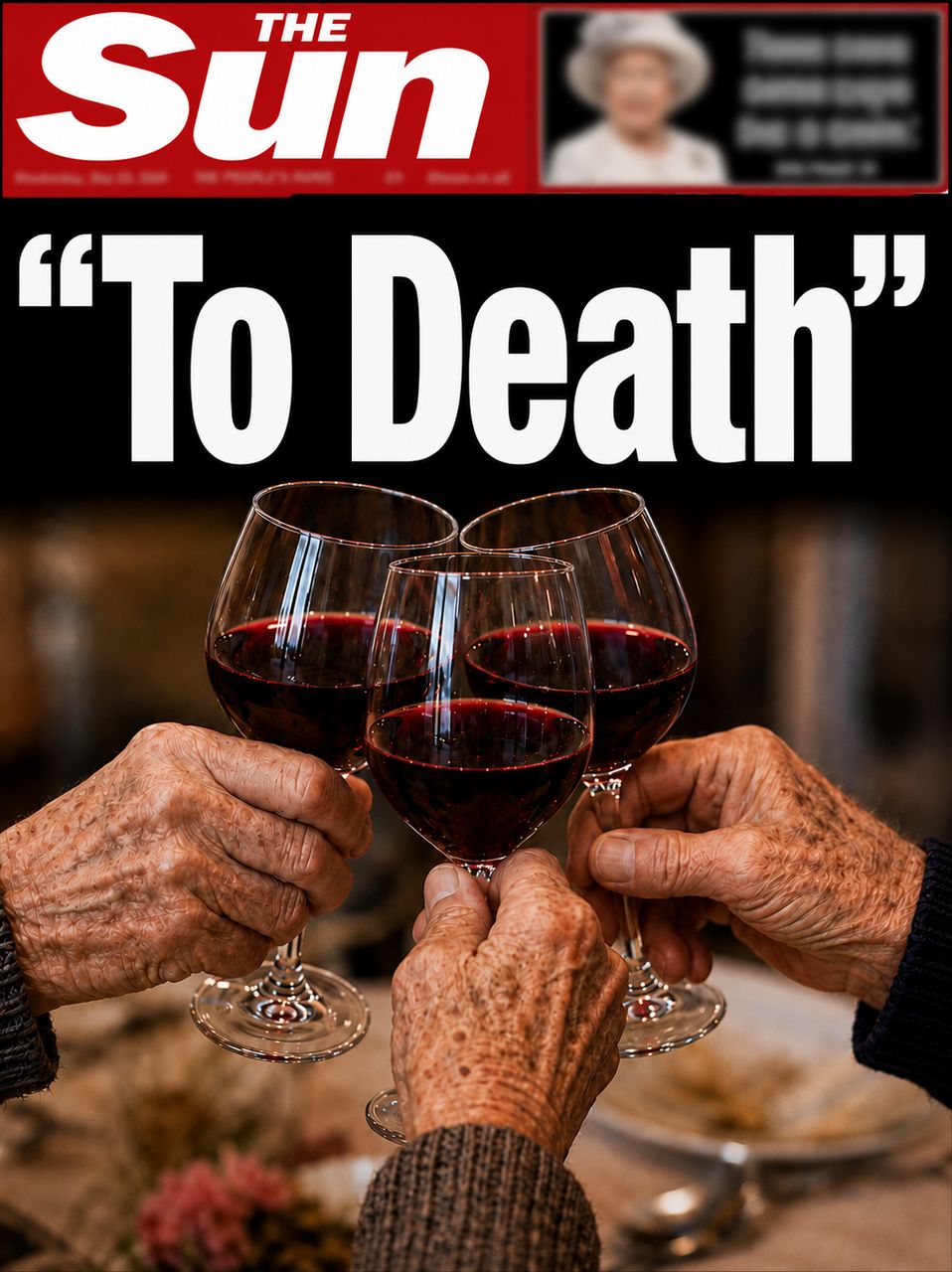
The Luton police got to the truth very quickly, and Morty did not bother hiding it. What would have been the point? His trial soon became one of the most famous in 1990s England, spoken of in the same breath as the O. J. Simpson trial. The front page of the London tabloid The Sun on the opening day is still remembered as one of its great covers: a photograph of the three of them smiling at the camera, happy, touching glasses of clear red wine, under the headline “To Death”.
The subheading read: “Morty’s defense: Paul and Donna wanted to die”.
The argument in court was not about the facts. The court accepted Morty’s account in full. Donna and Paul had said, again and again, that they wanted to end their lives. They had even spoken with him about concrete plans to do it.
“Come on, let’s end this together”, Donna had told him just one week before she was poisoned.
The judges believed him, but that didn't matter. Donna and Paul had not agreed to die on that Friday, February 28, 1992. Whatever else they had wanted, whenever else they had wanted it, was beside the point. There had been a wish to die, yes. There had not been consent.
The 93 year old was convicted of double murder and sentenced to sixty years in prison. If he entered prison alive, he would leave in a black bag.
Because of his age, because he was no danger to the public, and because no one seriously believed he would flee justice, he stayed at home throughout the trial. After sentencing, he was given one month before entering prison. He spent most of it drinking, remembering his late wife, and remembering the three of them together, those splendid nights when they drank to life and drank to death.
A week before his prison date, he reported to the prison doctor, as people his age were required to do.
The doctor told him that all in all, for a man his age, he was in good health. He was also not terribly impressed by the dementia diagnosis.
“With results like these, I would not diagnose you with dementia”, the doctor said. “Old people forget things. That is not news”.
Morty was furious.
“How can you say that? In the last two weeks alone I forgot this, and this, and this”.
“I am not impressed by people who remember so well what they forgot”, the doctor said with a smile. “Come back when you forget what you forgot”.
The doctor did not know that Morty had exaggerated a little years earlier in order to secure the dementia diagnosis. “But the DSM says”, Morty began, and then quoted, with perfect accuracy, the symptoms and diagnostic criteria. The doctor stopped him halfway through.
“Morty, are you really quoting the manual word for word to prove to me that your memory and grip on reality are failing”?
Morty understood the trap. If he said nothing, the doctor would think he was not demented. If he proved the doctor wrong, he would prove him right.
He had always believed that once dementia began to hit, the end would come quickly. Now he understood that this was not necessarily so.
In a defeated voice, he asked, “Doctor, how long do you think I could survive in prison”? “It could be several years”, the doctor said, assuming this would comfort him. “For your age, you’re in relatively good health”.
At the words “several years”, Morty’s face fell, and it had not been especially lifted to begin with. For him, this was a death blow. Or a life blow. Take your pick.
“Over my dead body”, he said. He ended the meeting, went home, and decided he would not enter prison.
The next day, he shot himself in the head with a gun belonging to his nephew, a volunteer police officer.
The following morning, The Sun returned to the iconic photograph: three old people, smiling, bright, alive, raising glasses of red wine.
This time, the headline quoted the only sentence Morty left in his suicide note:
“Always choose life, and only life. Until you cannot anymore”.